


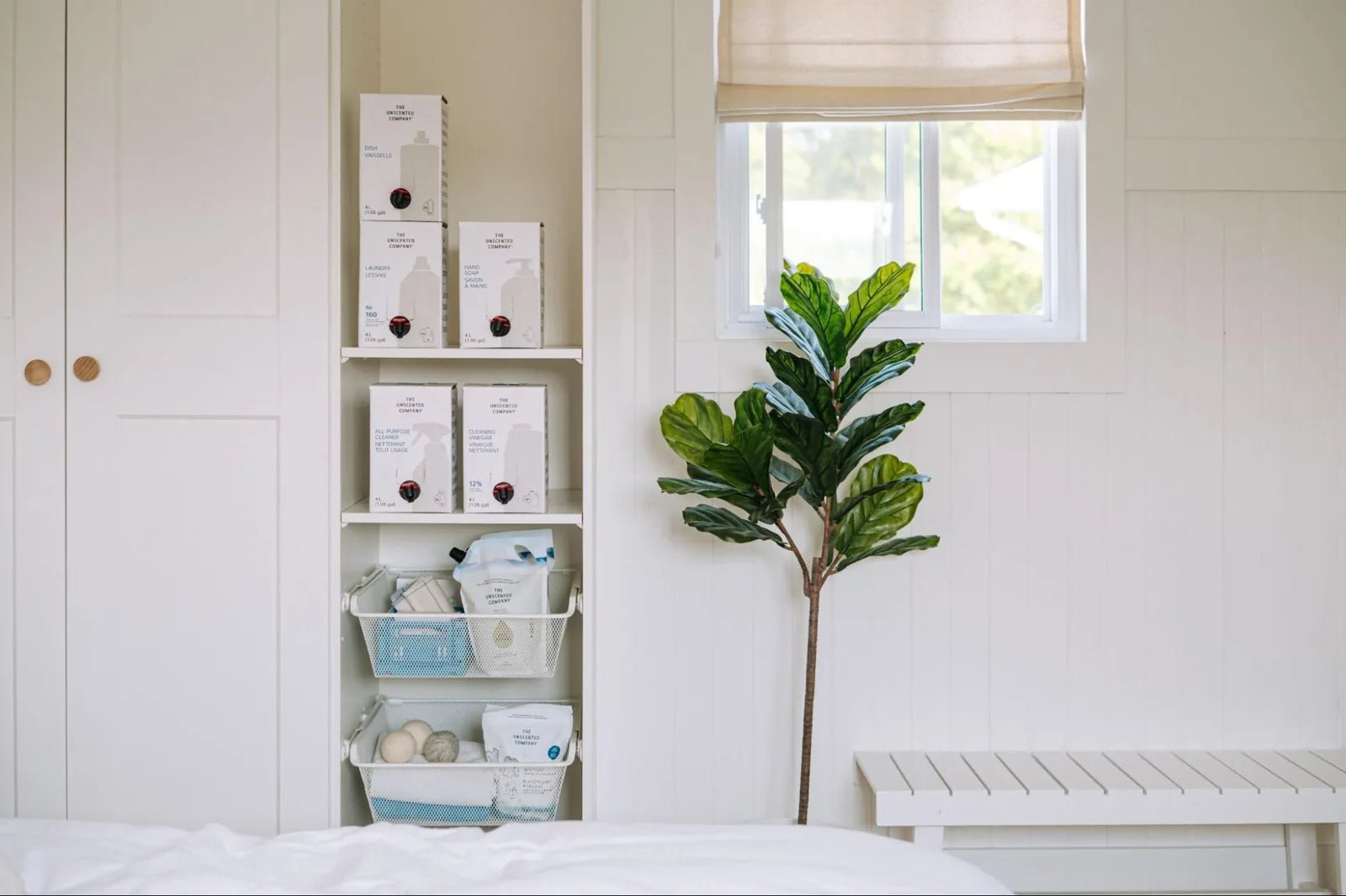
An at-home refill station replaces a buying habit most of us grew up with: one bottle per product, tossed once it’s empty. The principle behind refills is simple. You keep a few main containers in the house and top them up from a larger-format refill.
The system is gaining ground in Quebec, driven by a push to cut single-use plastic and simplify storage. This guide explains how a station like this works, what you can expect to save, and how to set one up at home without reorganizing anything.
Table of contents
- What an at-home refill station is
- How an at-home refill station works
- How much you save with a refill station
- Which household products suit refill formats
- How to set up a refill station at home
- Conclusion
- FAQ
What an at-home refill station is
An at-home refill station is a storage corner organized around a few reusable containers and their larger-format refills. The most common setup is a bin or a shelf holding the refill formats, close to where the products get used.
Instead of buying a new hand soap every time, you keep, say, a 500 ml bottle in the kitchen and another in the bathroom. When they run out, you top them up from a 4 or 10 litre container kept in a cupboard or under the sink. Once that container is empty, it can often go back to the manufacturer or into recycling, depending on what your area accepts.
The same logic applies across several product categories: hand soap, laundry detergent, all purpose cleaner, shampoo, body wash.
The system needs no special equipment. A basic funnel is enough for transferring, and the original containers are built to be reused several hundred times.

How an at-home refill station works
In practice, the station runs on a three-step cycle:
The initial fill
At the start, the household buys its main containers once, in their usual format: a pump bottle for hand soap, a bottle with a dosing cap for laundry detergent, a spray bottle for all purpose cleaner. Those containers then stay in the house for years.
Everyday use
For weeks or months, those bottles get used normally. No change to the routine. When one of them is running low, you simply plan a refill.
Topping up from the refill
Once a container is empty or nearly empty, you top it up from the refill container. The whole thing takes seconds. Cap the main container, put the refill back in the cupboard, done. No unboxing, no label to peel off, no replacement pump to buy.
For households that want to try this setup, our at-home refill station is a kit built for an easy start, with the main containers and one refill format included.

How much you save with a refill station
The savings an at-home refill station delivers show up in two places: what the products cost, and how much plastic comes into the house.
On product cost
Refill formats generally carry a lower price per litre than individual containers. The difference comes from the packaging: a 4 litre container takes less material, less transport and less packaging than eight separate 500 ml bottles.
Depending on the product and the brand, the gap commonly lands between 20 and 40 % per litre. Over a year, for a household that goes through hand soap, laundry detergent and an all purpose cleaner regularly, the difference becomes measurable.
On plastic volume
The impact shows up on the way out, too. A 10 litre refill format replaces the equivalent of 20 bottles of 500 ml. The weight of plastic put into circulation drops accordingly.
The table below gives a sense of the scale, based on an average household using three common products in refill format.
|
Product |
Buying individually over 1 year |
In refill format over 1 year |
Plastic saved |
|
Hand soap |
8 bottles of 500 ml |
1 container of 4 L |
7 bottles |
|
Laundry detergent |
6 bottles of 1.5 L |
1 container of 10 L |
5 bottles |
|
All purpose cleaner |
6 spray bottles of 750 ml |
1 container of 4 L |
5 spray bottles |
Nationally, Environment and Climate Change Canada places the shift toward a circular economy and moving away from single-use items among the central pillars of its plan to reduce plastic waste.
In Quebec, RECYC-QUÉBEC supports that transition with tools and concrete examples of reusable systems, noting that cutting back on single-use products pays off for the environment and the wallet alike.

Which household products suit refill formats
In an at-home refill station, not every product lends itself equally well to a refill format. A few simple criteria help identify the ones worth prioritizing.
The products best suited to a refill system include:
- liquid hand soaps, used in large quantities in the kitchen and the bathroom
- liquid or gel laundry detergents, where monthly volume runs high
- all purpose cleaners, which get used in several rooms
- body washes and shampoos, especially in larger households
- dish soaps, which get used steadily
Aerosols, pressurized sprays and certain disinfectants are less suited to transferring, for technical or regulatory reasons. The manufacturer’s instructions usually indicate whether a product can be repackaged.
For households just starting out, one or two products is plenty. Hand soap and all purpose cleaner are often the first candidates, because they are easy to top up and the containers turn over quickly. Laundry detergent or shampoo can come later, as the routine settles in.
How to set up a refill station at home
Setting one up takes no equipment and very little space. A shelf under the sink, a corner of the laundry room or a bathroom cupboard is generally enough.
Here are the steps for putting a refill station together at home:
- identify three to five products you go through often enough to justify a refill
- keep your current main containers, emptied and rinsed with lukewarm water
- set aside a spot for the refill containers, within easy reach and away from heat
- buy a simple funnel, which will serve for every transfer
- label the containers if several products are stored in the same place, to avoid mix-ups
- note the refill dates if you want to track your consumption over the months
On upkeep, the main containers can be rinsed every three to five refills, particularly for thicker products like laundry detergent. Lukewarm water is enough in most cases.
A few common mistakes to avoid. Mixing different products in the same main container, even from the same brand. Leaving a refill container open for months without capping it properly. Reusing a food container for a household product, which can lead to confusion.

Conclusion
An at-home refill station turns a recurring spending category into a simpler routine, cheaper per litre and with less plastic circulating through the house. Setting one up takes only a few containers and a funnel, and it can happen gradually, one product at a time.
To start with a set built for the home, take a look at our refill collection, which carries the most common formats for household and personal care products.
FAQ
Does an at-home refill station really save money?
Yes, over time. An at-home refill station runs on large-format containers that generally cost 20 to 40 % less per litre than individual bottles, depending on the product category. The saving becomes meaningful after several months of use, particularly for products you go through regularly, like laundry detergent and hand soap.
How many times can a container be reused before it needs replacing?
Plastic containers designed to be reused generally handle several hundred refills without losing quality. The signs a container has reached the end of its life are cracks in the bottle, a cap that no longer closes properly, a pump that seizes up or a spray head that no longer sprays evenly. At that point the container can be recycled through whatever streams your municipality offers.
Do containers need rinsing between refills?
Rinsing with lukewarm water every three to five refills is enough in most cases, particularly for thicker products like laundry detergent or hand soap. For heavily diluted all purpose cleaners, topping up directly is usually fine without rinsing. It is still best not to mix different products in the same container, even within the same line.